Aquaponics, how does it work?
Aquaponics means raising fish and growing plants in the same closed loop, with no soil, no synthetic fertiliser and 95% of the water recycled. Here is how the mechanism works, step by step.
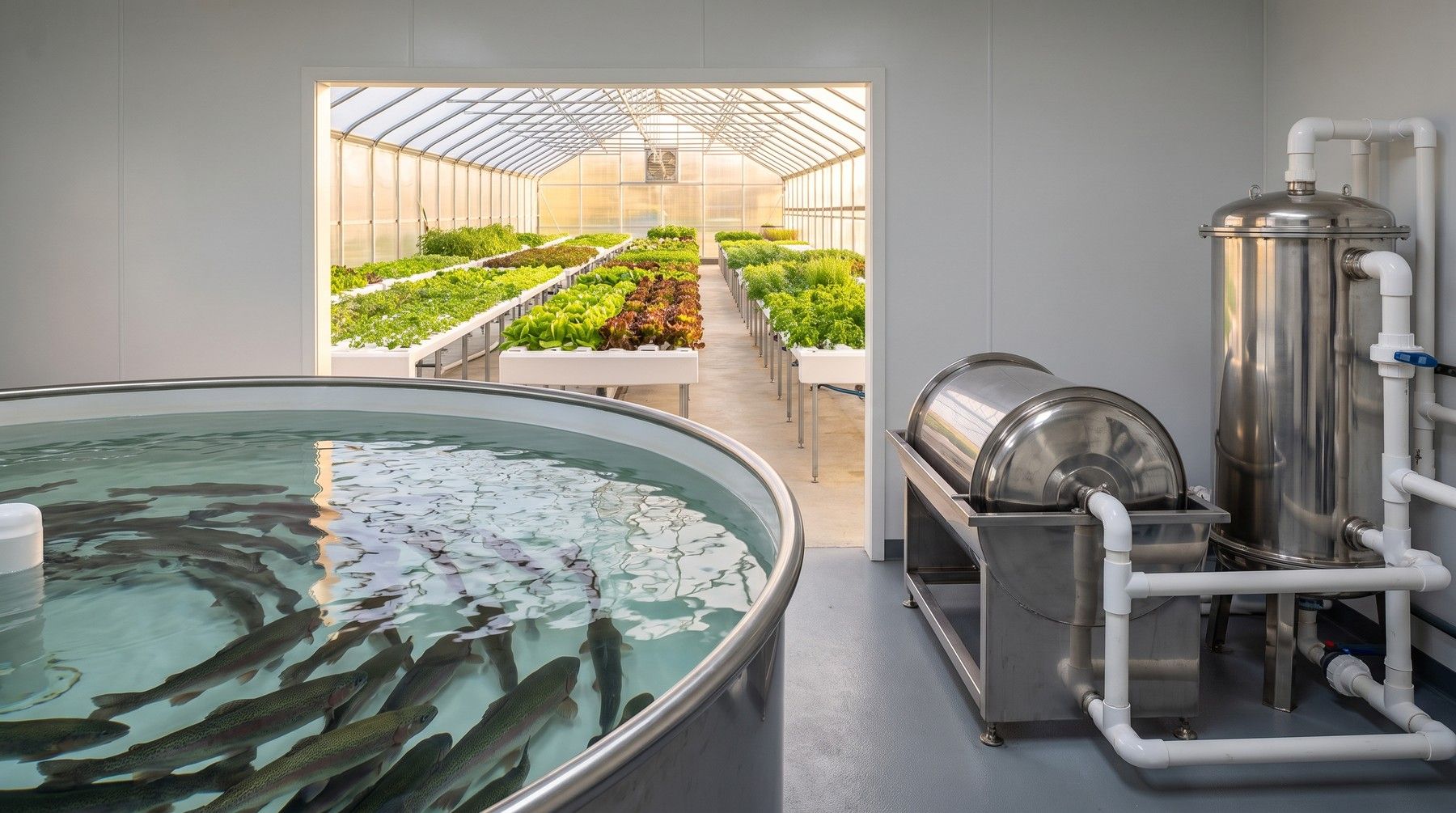
Aquaponics brings a fish farm and soilless growing together in a single closed loop. Fish waste, converted by bacteria, becomes the fertiliser for the plants, which clean the water before it flows back to the tanks. The principle fits in three lines. Running it day after day takes real expertise.
Here is how the mechanism works, from the nitrogen cycle to the path the water takes, and what it means in practice on a commercial farm like the one we are building in Moselle, in north-eastern France.
Three crops in one closed loop
An aquaponic farm in fact runs three crops in the same closed loop: the fish, the bacteria and the plants. Take any one of them out and the balance collapses.
The fish are fed and load the water with ammonia, through their waste and through their gills. Nitrifying bacteria, growing on the media of a biofilter, convert that ammonia into nitrate. The plants take up the nitrate exactly as they would take up a fertiliser, and hand the water back clean. The loop is a genuine virtuous circle.
What conventional farming buys as synthetic fertiliser, we produce in our own tanks, from the feed given to the fish and from their waste.
The nitrogen cycle, engine of the system
An aquaponic system runs on the nitrogen cycle. The ammonia the fish excrete is toxic to them at very low doses. In its un-ionised form, the one that crosses the gill membrane, the safety thresholds used for rainbow trout are counted in hundredths of a milligram per litre, which leaves the operator an extremely thin margin for error.
Two bacterial steps follow one another. The first converts that ammonia into nitrite, which is toxic as well. The second turns the nitrite into nitrate, the form of nitrogen plants take up best and that fish tolerate at far higher concentrations. By consuming the nitrate, the plants clean the water and close the cycle.
Nitrate, unwanted in a fish tank, is precisely the form of nitrogen plants take up best. The waste of one becomes the resource of the other.
What genetic analysis changed
Textbooks long credited these two steps to two specific bacterial genera, Nitrosomonas then Nitrobacter. Molecular analyses carried out over the past decade on real aquaculture biofilters tell a richer story. The genus Nitrospira most often dominates nitrite oxidation there, while Nitrobacter sometimes turns out to be absent altogether. Work published in 2017 on a trout farm biofilter found not a single sequence of it.
The same research has identified ammonia-oxidising archaea, along with so-called comammox bacteria, able to carry out both successive conversions on their own. The make-up of this consortium varies from one installation to another with temperature, pH, nitrogen load and salinity.
For the operator, the practical consequence is unchanged. What matters is not naming these micro-organisms, but giving them a surface they can colonise, oxygenated water and enough alkalinity.
The water loop, step by step
In a commercial installation, the water follows a precise path and closes back on itself. It leaves the fish tanks loaded with suspended solids, then passes through mechanical filtration, usually a drum filter, which catches the solid particles before they break down and consume the oxygen in the loop.
It then reaches the biofilter, where the nitrogen conversion described above takes place. From there it is distributed to the growing areas, floating rafts for leafy greens or gullies depending on the variety. Cleaned by the roots, it finally returns to the tanks once its temperature, dissolved oxygen and pH have been checked.
Only losses to evaporation and plant transpiration have to be made up, on the order of 1 to 3% of total volume per day. The closed loop therefore recycles about 95% of the water, where an irrigated open-field crop loses almost all of it. This water saving is the first advantage of commercial aquaponics in a climate where irrigation is becoming a constraint.
Cycling, or why a farm starts slowly
These bacteria do not settle in on demand. Depending on conditions, expect three to eight weeks to establish a stable population, the stage practitioners call cycling. The ammonia oxidisers colonise the biofilter five to seven days after the first nitrogen input, the organisms that handle nitrite take over a week later, and the system is judged mature only once nitrite has returned to zero and nitrate is rising steadily.
Several levers shorten this phase. Seeding the biofilter with media taken from a system already running remains by far the most effective. Holding the temperature at the top of the bacterial range, keeping alkalinity high and feeding ammonia steadily all help too.
This start-up phase is why an aquaponic farm produces later than a hydroponic greenhouse, which yields from its very first crop.
pH and iron, a permanent compromise
pH is the parameter where the three compartments disagree most sharply. Plants prefer clearly acidic water, around 5.5 to 6.5. Nitrifying bacteria work better above 7. Fish accept a wider range. Aquaponic practice therefore settles on a compromise between 6 and 7, where nobody reaches their optimum but everybody works properly.
That pH does not hold on its own. Nitrification is an acidifying reaction, and the carbon dioxide the fish release forms a weak acid, so the system naturally drifts downwards. The operator buffers by alternating calcium and potassium carbonates, which corrects the acidity and, in the same move, fills the two structural gaps of aquaponics: potassium and calcium, which fish feed does not supply.
Then there is iron. Above pH 7 it precipitates into a form roots can no longer take up, and chlorosis appears on the young leaves. Chelated iron is therefore added, on the order of 1 to 2 milligrams per litre, during the first months and then as needed. These supplements are soluble and harmless to the fish, and their cost stays marginal next to the complete fertilisers a hydroponic system requires.
What a farm produces, and how it is sized
An aquaponic farm combines two trades, fish farming and soilless market gardening. Species selection is driven first by temperature, since fish sharing a loop have to share a temperature range. In a temperate climate, rainbow trout and brook trout meet around 13 to 16 °C and are easily kept together. Pikeperch, which needs distinctly warmer water, belongs in a separate unit, which is why a farm designed for several species keeps its rearing halls apart.
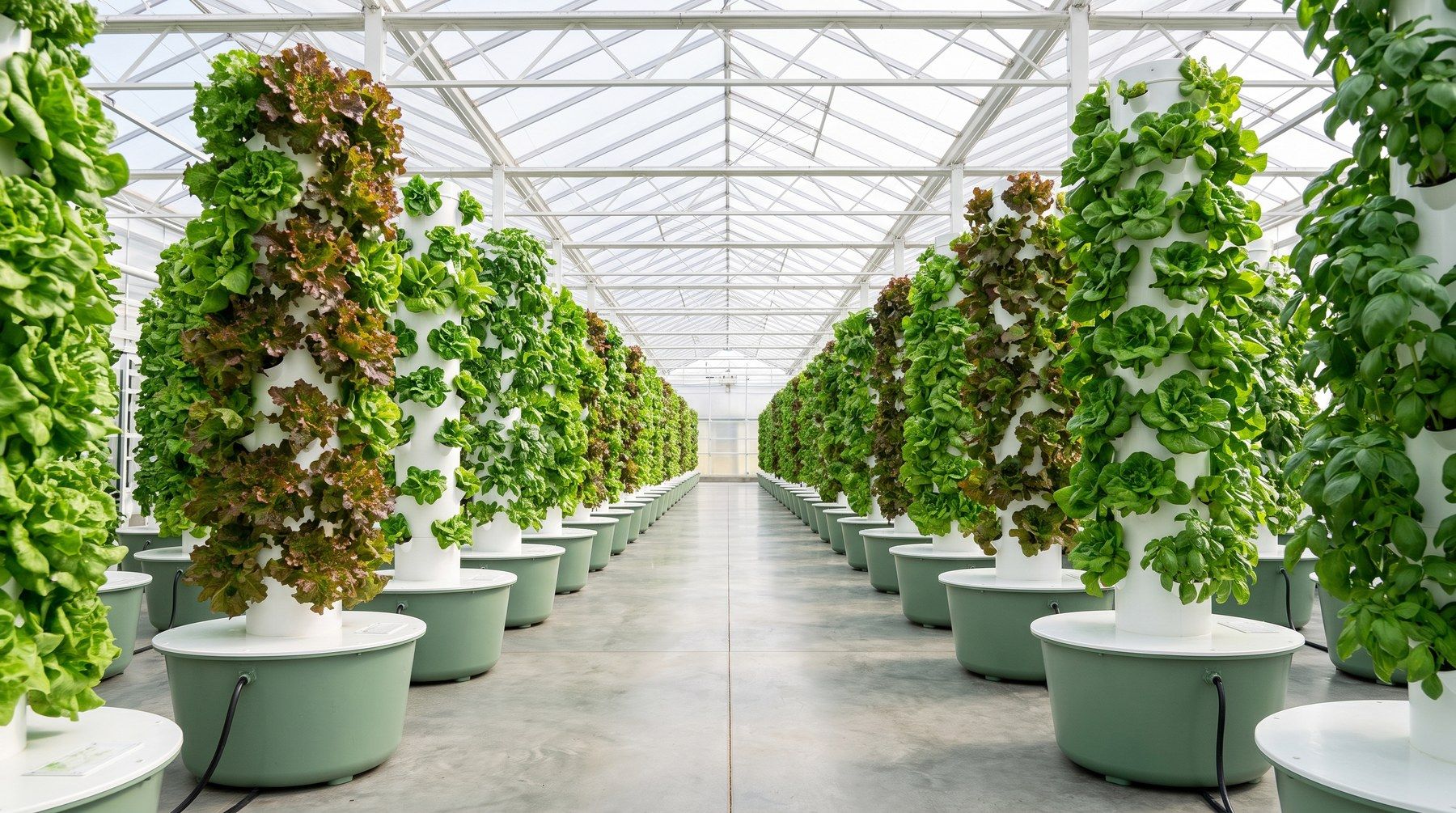
On the plant side, short-cycle crops with a high nitrogen demand make the best use of the system, which is the case for salads and herbs. Summer fruits are possible too, tomato, pepper, aubergine, courgette or strawberry, although decoupled aquaponics is often better suited to those crops.
Sizing, finally, is not calculated in kilograms of fish but in the amount of feed given each day. The FAO uses 40 to 50 grams of feed per square metre of growing area per day for leafy greens, and 50 to 80 grams for fruiting vegetables. Fish output is then derived from that input and from the feed conversion ratio, close to 1 for trout in modern farming. Balancing an aquaponic system therefore means thinking in terms of a flow, not a stock.
What the system consumes, and what it rules out
Water is where the advantage is clearest, for the reasons set out above. Energy, on the other hand, is the real issue. An aquaponic farm is very energy-hungry, above all for electricity, because pumps, aeration and filtration run without interruption, on top of heating or cooling systems depending on the site. There are ways to lighten that cost, from on-site solar power to heat pumps, and as far as recovering waste heat from a neighbouring site. That is the route we are taking on our project.
Land, by contrast, becomes secondary. Since the crops need no soil, a brownfield site, poor ground or a plot on the edge of a town works perfectly well, which allows the farm to sit as close as possible to where the food is eaten.
One last point sets aquaponics radically apart from other soilless methods. In a loop where fish, bacteria and plants all depend on one another, no synthetic treatment is possible. An antibiotic given to the fish would sterilise the biofilter and trigger an immediate ammonia spike. An insecticide sprayed on the crops would run back down into the tanks. Crop protection therefore rests on releasing beneficial insects, on managing the climate under cover and on monitoring pest populations every day. Aquaponic produce is free of pesticides and antibiotics by design, which places it firmly within sustainable agriculture.
Our approach at Vic-sur-Seille
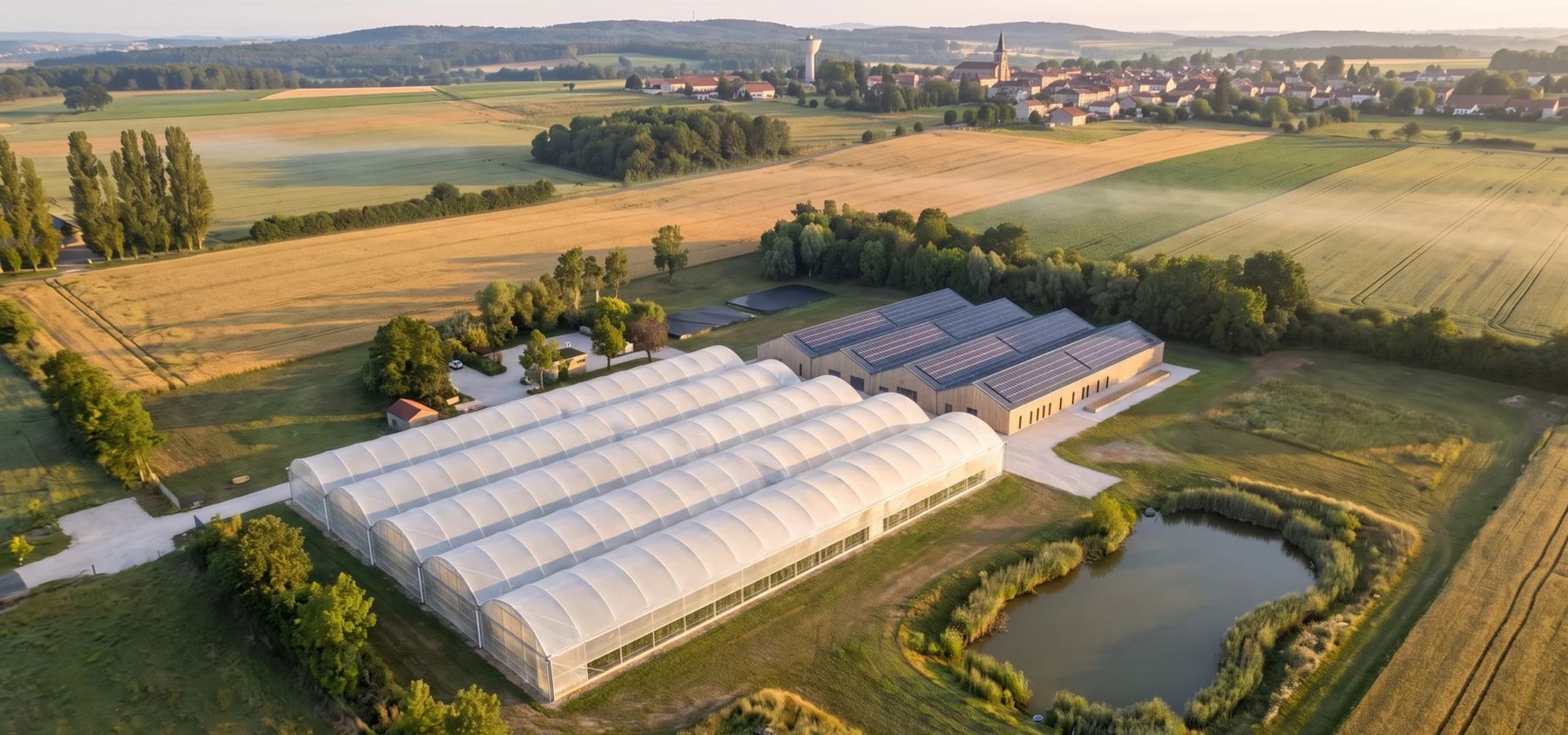
We are applying these principles on our large-scale aquaponic farm project at Vic-sur-Seille, in Moselle. Three fish rearing halls, four production greenhouses, a research greenhouse and a processing workshop will be organised around a single water loop.
The production target is around sixty tonnes of fish and thirty-five tonnes of plants a year, close to seventy-five tonnes of net food. That scale was chosen as a fair balance. Our model is not the mega-farm but a human-scale operation, large enough to matter in the food supply of a whole population area, measured enough that everyone knows their plants and their fish and tends to them every day. Our produce will be sold within a hundred-kilometre radius of the farm, and the local trade buyers we have met are keen for this local supply.
The project is now in its fundraising round, with grants already secured under France 2030, France's national investment programme, and you can take part in it too, so that construction can start in 2027. Designed to be replicated, this first farm will serve as the model for the next ones, in other population areas.
So how does aquaponics really work?
The principle fits in one sentence. Feed enters the loop, it feeds fish whose waste is converted by bacteria into a fertiliser the plants consume, and the water, now cleaned, returns to the tanks.
Everything then rests on the day-to-day management of that balance: feeding the fish properly, tracking the water parameters, watching the health of the stock and of the crops. This work will be done by a team of around ten people, backed by a set of proven automated systems that support them day after day.
Our farm will therefore run two complementary productions on a single infrastructure, without depending on any synthetic fertiliser, and using five times less water than open-field agriculture. That is what makes aquaponics one of the most practical tools for the agricultural transition and for food sovereignty, bringing sustainable local production closer to where the food is eaten, through short supply chains. We looked at this in detail in our article Aquaponics, hydroponics, aeroponics: what is the difference?.
Frequently asked questions
What is aquaponics exactly?
Aquaponics is a farming system that combines fish rearing with soilless growing in one shared water loop. Fish waste, converted by bacteria, feeds the plants, and the plants clean the water before it returns to the tanks.
Do you need fertiliser in aquaponics?
Very little. Plant nutrition comes from the nitrogen produced by the fish and converted by bacteria. A few supplements are still needed, mainly chelated iron, along with the potassium and calcium added when buffering the pH. These inputs remain nowhere near a full hydroponic fertiliser programme.
How much water does an aquaponic farm use?
Because the loop is closed, only losses to evaporation and plant transpiration are made up, roughly 1 to 3% of the volume per day. The system recycles close to 95% of the water it holds, where an irrigated open-field crop loses almost all of it.
Which fish and vegetables can be grown together?
In a temperate climate, rainbow trout and brook trout share the same temperature window, around 13 to 16 °C, and can be kept in a single loop. Pikeperch needs warmer water and belongs in a separate unit. On the plant side, salads, herbs and baby leaf make the best use of the system, ahead of summer fruits such as tomato, pepper or strawberry.
Can you use pesticides in aquaponics?
No. A synthetic pesticide sprayed on the crops would run back down into the fish tanks, and an antibiotic given to the fish would destroy the biofilter. Crop protection relies entirely on biological methods, which guarantees produce that no chemical treatment has ever touched.
How long before the first harvest in aquaponics?
Establishing a stable bacterial population takes three to eight weeks, a stage known as cycling, before the system is gradually stocked. The first plant harvests follow soon after, while the fish follow the growth cycle of each species.
Can aquaponic produce be certified organic?
Not under European law as it stands. Regulation 2018/848 bans hydroponic production, and the official French interpretation guide places aquaponics squarely in that category for plants. The same text also rules out aquaculture in closed recirculating systems. An aquaponic farm can therefore grow without a single synthetic treatment and still not qualify for the AB organic label, France's organic certification, a situation the sector regards as a regulatory blind spot.