Why invest in aquaponics in 2026?
In France, nearly three quarters of the fish are imported, water is growing scarcer and aquaponic supply remains almost non-existent. Here is why this case deserves the attention of an investor in 2026.
Five findings now point in the same direction, and none of them is a matter of opinion.
- Dependence on imports. Nearly three quarters of the fish eaten in France comes from abroad.
- Food safety under scrutiny. Heavy metals and microplastics in wild fish, antibiotics in some farming operations, pesticide residues on 80% of fruit and 48% of non-organic vegetables tested in France.
- Farming that has to adapt to climate change. Droughts, summer water restrictions and erratic open-field yields: that is what 2026 has been for farmers right across Europe.
- A water supply that is running short. In France, the summer of 2026 put 72 of the country's départements in a state of crisis, against 46 a year earlier.
- Demand shifting towards healthy and local. 83% of French consumers buy local products and 76% check the origin of what they eat, as long as the price is not seen as excessive. The big retail chains are writing that expectation into their supplier specifications.
Against these five findings stands an absent supply. The French aquaponics market is still in its infancy, with a handful of commercial farms for the whole country. The Grand Est region, where we are setting up, has no large-scale farm at all.
France is not an isolated case. More than 80% of the seafood consumed in the European Union is imported, according to a study commissioned in 2026 by the European Parliament's fisheries committee. Worldwide, aquaculture overtook capture fishing in 2022, with 94.4 million tonnes of farmed animals, but ten countries supply nearly 90% of it. Most consumer nations therefore depend on a handful of distant producers.
Investing in an aquaponic farm is not only an activist investment. It is a judgement based on hard figures: a need for food self-sufficiency, a farming sector that has to adapt to climate change, and a market where local supply is still entirely to be built.
Here is what that market shows, what aquaponics is, what it changes economically and how we address the risks:
A food dependence that has become structural
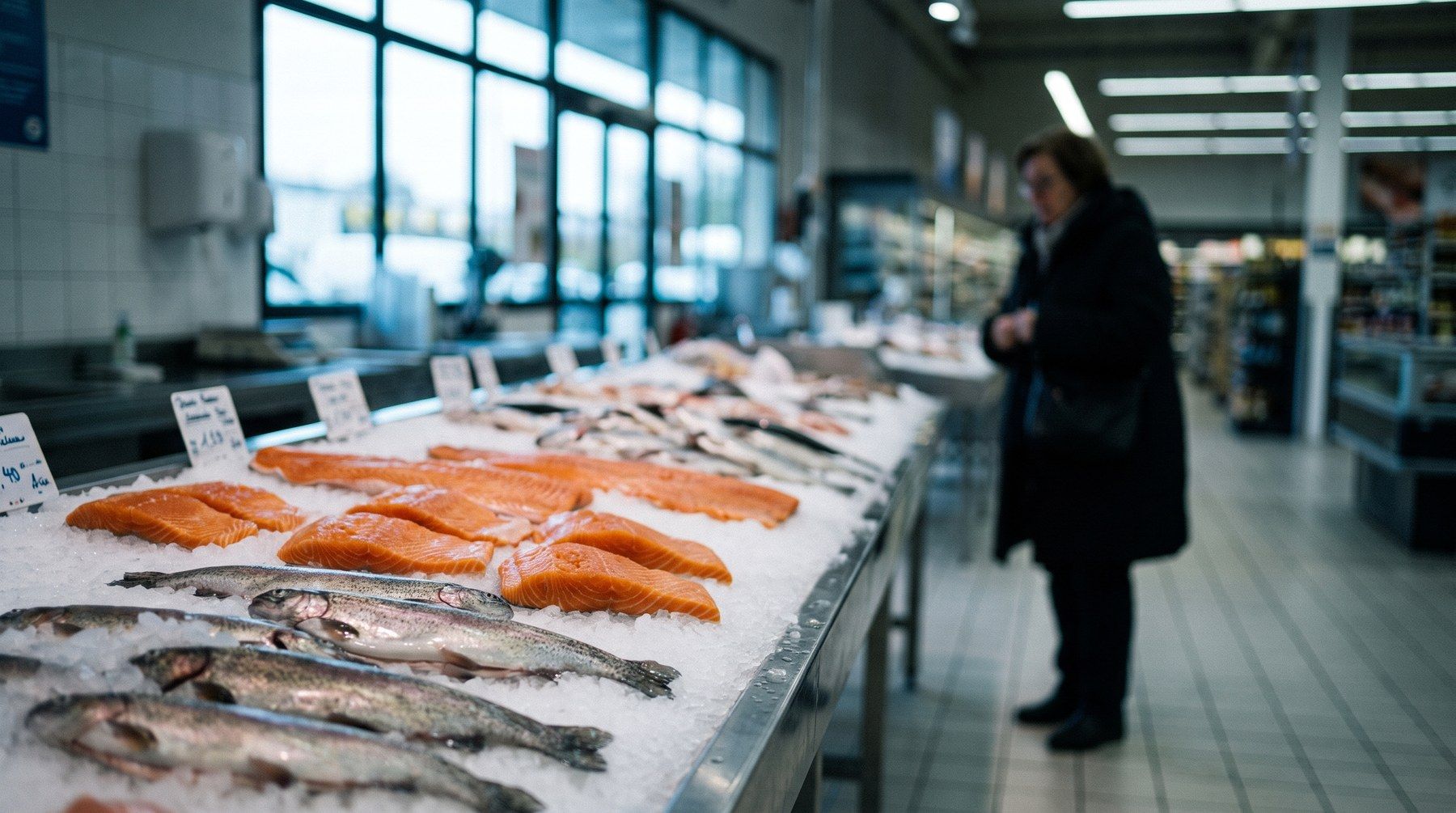
The most telling figure in this case is not an aquaponics figure, it is a foreign trade figure. According to FranceAgriMer, the French agricultural and seafood products agency, France's self-sufficiency rate for fish stands at around 24% on average over the 2022-2024 period, and its import dependency rate reaches 93%. For every four fish eaten in the country, three come from elsewhere.
The two indicators do not contradict each other. The second compares imports with domestic consumption without deducting what France re-exports after processing. Read together, they describe a vast domestic market served by residual national supply, and they raise the question of our food sovereignty.
A sector that imports the equivalent of 93% of its consumption does not have a demand problem. It has a local supply problem.
This is more interesting than a growth curve, because the market exists before production even starts and depends on no change in consumer behaviour. There is no market to create, only a share to win back.
Salmon and trout, a shift in buying already under way
One species sums up that dependence on its own. In forty years, salmon has gone from a rare fish to a mass-market product, driven almost entirely by aquaculture. The global market is now worth $19.1 billion and is expected to more than double by 2034. France is the largest consumer in Europe and the fourth largest in the world, with around 228,000 tonnes a year, for a per-capita consumption that has doubled in twenty years.
That salmon comes almost entirely from abroad, and its price has risen sharply. The average export price of Norwegian salmon went from around 59 kroner per kilogram in 2021 to 95 in 2023, before easing back to 82 in 2025, a level that remains well above previous years. Mortality in open-sea pens and sea lice outbreaks account for most of that pressure.
The shift in buying towards trout is not a hypothesis, it can already be measured. French processing plants have more than tripled their smoked trout output, from under 2,000 tonnes in 2005 to around 6,450 tonnes in 2024, and trout now accounts for 19% of the French smoked salmonid market, against 7% twenty years ago. Its advantage is decisive, because it can be farmed in France, a few kilometres from the consumer. That is precisely the species we will produce.
Aquaponics, and what it changes economically
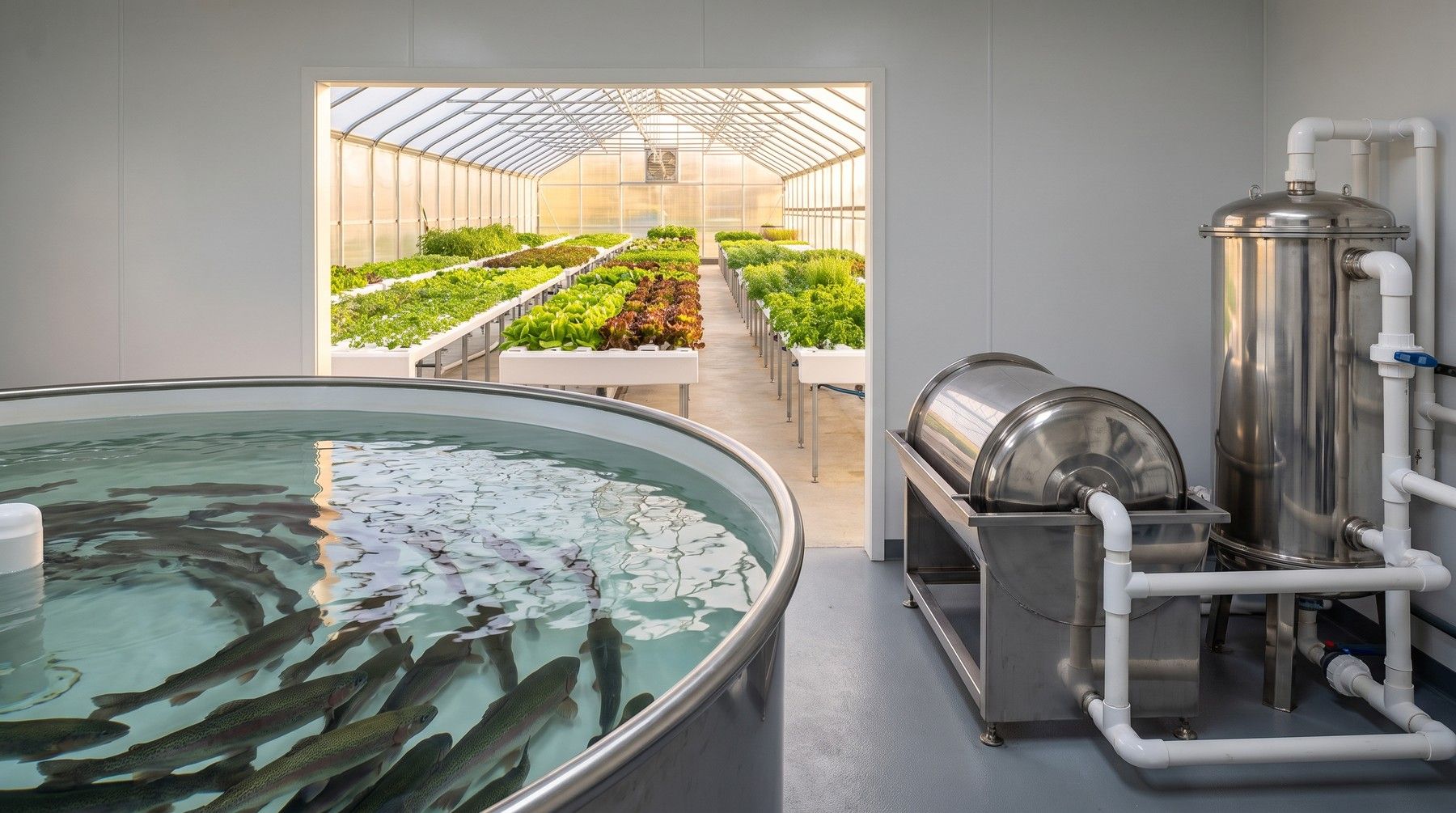
Aquaponics combines fish farming with the soilless growing of plants in a single closed loop. Fish waste loads the water with ammonia, which bacteria convert into nitrates the plants can take up. The plants absorb those nitrates and return clean water to the system, closing the loop and creating a genuine virtuous circle. We set the mechanism out in detail in our article How aquaponics works
This way of working has direct economic effects. Water becomes a stock rather than a consumable, since it circulates in a closed loop and losses are limited to evaporation and plant transpiration. Synthetic fertiliser disappears from the operating account, replaced by the feed given to the fish, which serves both to produce fish and to feed the plants. Greenhouse growing is also freed from soil quality and from part of the weather risk.
Running such a system requires continuous monitoring of the water parameters and allows no chemical treatment, which would kill the bacteria or the fish. That requirement is also what guarantees the quality of the final product, and it shows up in every analysis.
The absence of synthetic treatments is therefore a design constraint before it is a selling point. Our products cannot be certified organic, because the standard requires production in open soil, but they sit in the same segment: local, fresh, free of pesticides and antibiotics. A segment whose global market grew from €15 billion to €136 billion between 2000 and 2023.
Two productions, one infrastructure
This is the point investors grasp fastest. An aquaponic farm funds one building, one water loop, one team, and sells into two separate markets.
The two markets do not follow the same seasons, the same price cycles or the same buyers. When one weakens, the other holds steady or rises, so a balance sets in between the two productions. This internal decorrelation absorbs part of the volatility, which no single-product farm can do.
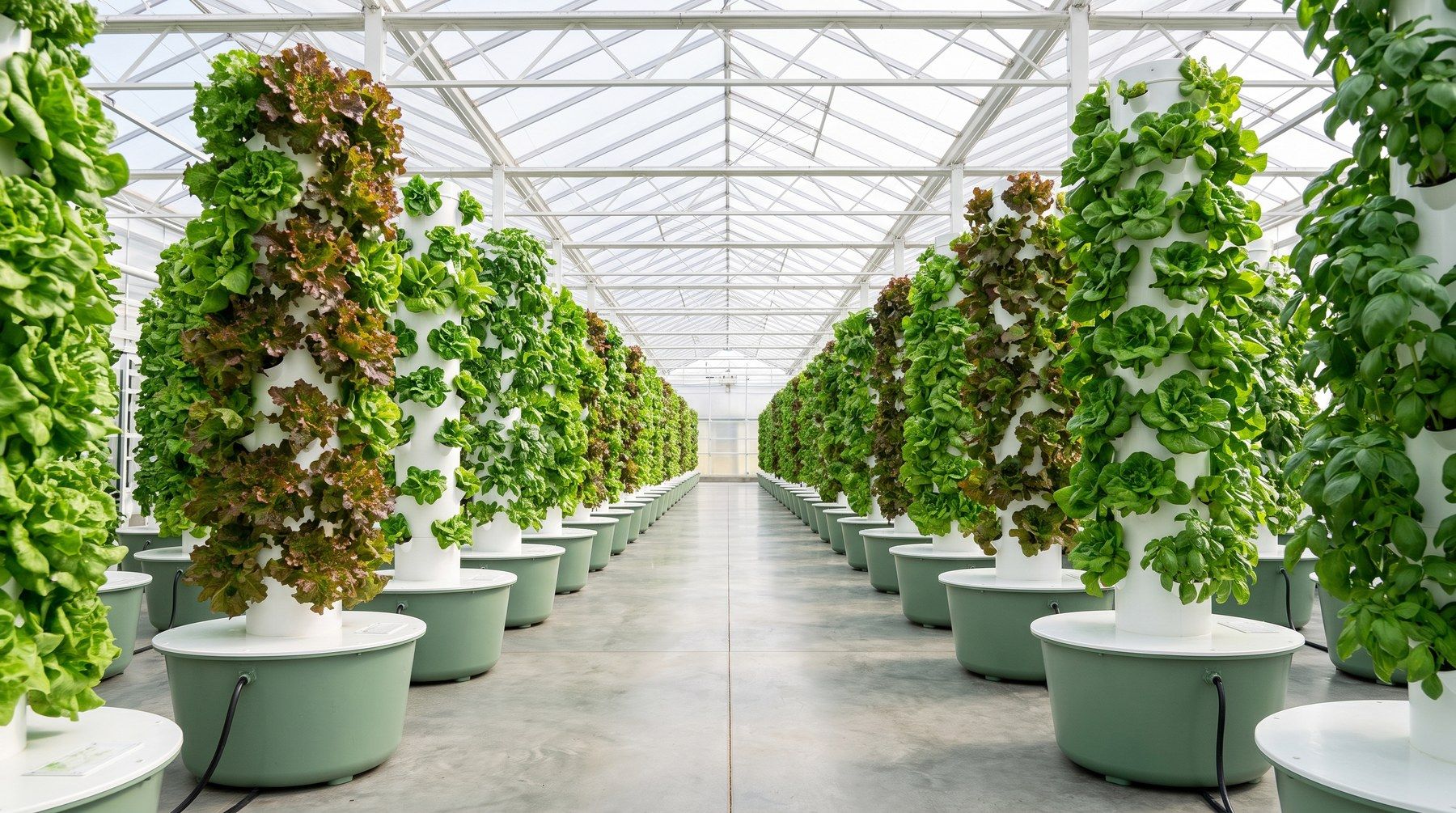
At Aquaponeasy, we make full use of this. Our farm will bring together several fish species, including rainbow trout and brook trout, and soilless market gardening covering a wide range of herbs, fruit and vegetables, part of which will be processed on site. This diversity strengthens the balance between our productions and opens up the segments with the most attractive margins, without making the farm harder to run.
Processing, a pillar of our model
Processing our products is a central part of our model, because the price of a whole trout and the price of a smoked trout fillet are not comparable. Processed products allow a far better margin and better returns for the project. At Aquaponeasy, we have therefore planned a processing unit from the outset, so that it is running from the first harvests.
The unit also brings flexibility. We will be able to combine our fish and our herbs, build our own range and run a number of trials, while turning perishable surpluses into storable products. It opens outlets that fresh produce alone does not reach, in particular direct sales, the channel that takes the most elaborate products and delivers the best returns.
It is also what turns the project from a farm exposed to wholesale prices into a business that controls part of its value chain. Our volumes will be split between supermarkets and farm shops for 60%, restaurants and institutional catering for 25%, and direct sales for 15%.
An open sector, and the right moment to enter it
Commercial aquaponics already exists, but it is still little developed. Several farms are operating in France, with different models, and the only available count, published in 2021 by ITAVI, the French technical institute for poultry and fish farming, listed eighteen of them, mostly small installations. We are therefore arriving at a pivotal moment, with enough experience from the field to build a solid project in a sector that is still open.
The global aquaponics market, all segments taken together, is expected to double between 2023 and 2030, at around 13% a year, with Europe accounting for close to a quarter of it. These estimates measure the interest in aquaponics as much as agricultural production itself, and it is the latter that we are positioned on.
Our model is a large-scale aquaponic farm, sized to produce genuinely significant volumes in an area with strong potential, and designed to have the widest possible impact. Grand Est, Saarland and Luxembourg have no farm of this size, and the first to set up there will be the best established. Being first to supply the region's large customers and to become known there is a lasting advantage, all the more so because you first have to obtain planning permission, secure the environmental authorisations, get the farm built and hold real expertise, which we already have.
Our local market, in figures
A farm is judged on its sales area. Ours covers Alsace, Lorraine, Saarland and Luxembourg, close to 6 million people. Every year it consumes around 22,000 tonnes of salmonids and 85,000 tonnes of organic fruit and vegetables, more than €500 million at wholesale prices, currently supplied mainly from abroad.
In our discussions with professionals in the sector, almost everyone we spoke to responded favourably. Demand for local products is real and local supply of fish is almost non-existent today, far from meeting demand. For some species, we would quite simply be the only producer in the area.
The order of magnitude is worth setting out. With four farms in the area within five years, our output would reach 380 tonnes for about €6.8 million in revenue, barely more than 1% of that market. Our growth therefore assumes neither an upheaval in consumer habits nor the capture of a significant market share.
The risks, and how we address them
Building and running a farm of this size carries risks, as does any industrial project. We have identified them from the experience of other farms, and each one was given an answer at the design stage of the project.
The commercial risk is the one we have covered best. We already hold letters of intent covering more than 100% of the production earmarked for B2B, which is 85% of the farm's volume, and many shops and restaurants in the area have not even been approached. There is still plenty of room for manoeuvre.
The industrial risk lies in the construction phase, where timelines and budgets always need watching. We have selected experienced contractors for each work package, from earthworks to greenhouse assembly, some of whom have already worked on aquaponic farms elsewhere in France.
The energy risk lies in electricity, our second largest cost after wages. We are working on installing photovoltaic systems on the site in order to consume part of that power ourselves and bring this cost down for the long term.
The biological risk, finally, is concentrated on the first fish deliveries, for as long as the nitrogen cycle is not established. We will rely on teams that have already run several start-ups, with critical equipment duplicated, spare parts on site and a permanent alarm system. Our fingerlings will be vaccinated against the main diseases, and each of the three species farmed will have its own water loop, with no exchange between the systems, which makes contamination of the entire stock impossible.
What we are building in Vic-sur-Seille
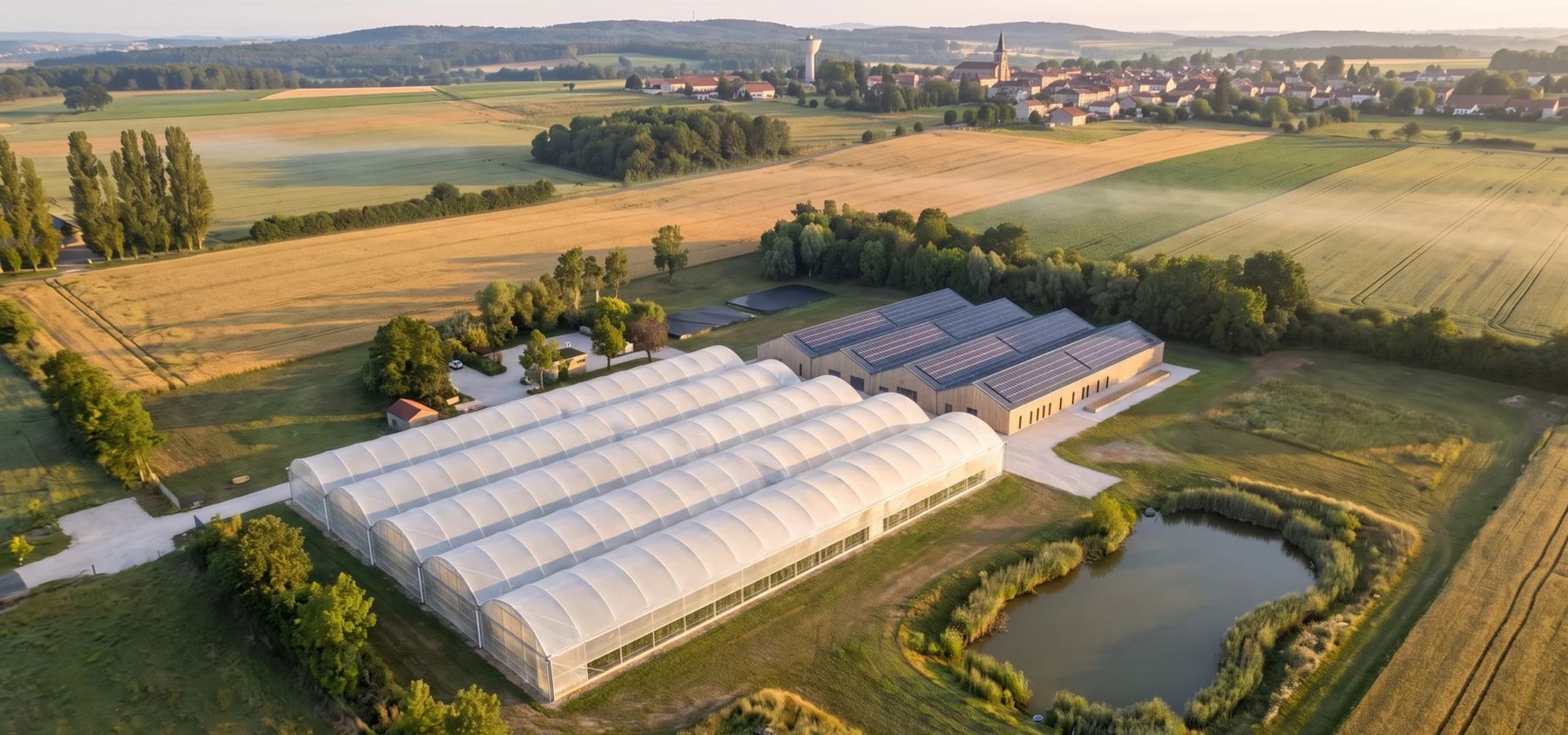
Aquaponeasy is building a one-hectare aquaponic farm in Vic-sur-Seille, in the Moselle, at the heart of Lorraine, in north-eastern France. The land has been secured since July 2025, the final design studies have been completed with several specialist engineering firms, and construction will start in the first half of 2027.
Three fish halls, four production greenhouses, a research greenhouse and a processing unit will be arranged around a single water loop. The farm aims to produce around 60 tonnes of fish and 35 tonnes of fruit and vegetables a year, sold through short supply chains within 100 kilometres, with profitability expected from the second year of production.
The project has already received funding under France 2030, France's national investment programme, and an application is under way to the EMFAF, the European maritime, fisheries and aquaculture fund, through FranceAgriMer. It holds the green guarantee from Bpifrance, the French public investment bank, and very strong political support. Our fundraising round is still open and it is possible to take part in it. It is open to private investors, through two separate vehicles, one to finance operations, the other to hold the land, a real asset backed by a lease.
Why invest now, in ten points
- A French dependence on imports. Nearly three quarters of the fish eaten comes from abroad, so the market exists before production even starts.
- A market already shifting towards trout. It accounts for 19% of the French smoked salmonid market, against 7% twenty years ago, as imported salmon becomes more expensive.
- Consumers who want healthy and local food. 83% of French consumers buy local products and 76% check the origin of what they eat.
- Climate change that calls for a fast response. Heatwaves are hitting Europe more and more, and the summer of 2026 put 72 French départements in a state of water crisis.
- Sustainable farming that is well regarded. Closed-loop growing, free of pesticides and antibiotics, saving around 95% of water, at the heart of the agricultural transition.
- A market still in its infancy. Eighteen commercial farms recorded in France, and no large-scale unit in Grand Est.
- A substantial sales area. Close to 6 million people in our zone, for more than €500 million of annual consumption at wholesale prices.
- Demand already committed. Letters of intent covering more than 100% of the production intended for professional buyers, signed before the first spade goes into the ground.
- A dual-revenue model. Fish farming and soilless market gardening on one and the same infrastructure, neither of which replaces the other, and both of which the processing unit adds value to.
- Solid public and political backing. France 2030 funding already received, a green guarantee from Bpifrance, and support that runs from the local council up to the highest levels of the French state.
There is also a feature specific to the sector. People keep eating in a downturn as much as in a boom, provided prices stay affordable. That is exactly our position, because the volumes a one-hectare farm produces allow us to stay within reach of the vast majority of consumers. Nothing will ever replace a tomato or a pikeperch fillet, and no technology will make that need obsolete.
What we are building in Lorraine also answers needs that we find everywhere on earth, in different forms. In regions short of water, producing locally becomes a necessity before it is a choice. Some countries struggle to modernise their farming model or to find labour, while others see their population grow faster than their harvests. Elsewhere again, markets place a high value on healthy products, and island or hard-to-reach territories have no alternative to local production.
This model is therefore meant to be replicated elsewhere, because aquaponics answers countless problems. Investing in the agriculture of tomorrow, and more precisely in an innovative production technology such as aquaponics, is both impact investment and conventional agricultural investment, backed by a need that will not disappear. We are of course focused on our first project in Lorraine, but we are already starting to build the Aquaponeasy vision for the years ahead.
If you would like to be part of it, invest in the project or get in touch with us directly. We answer every question, including the most technical ones.
Explore the investment opportunity→
Frequently asked questions
What is aquaponics, in short?
Aquaponics combines fish farming and soilless growing in a single closed loop. Fish waste, converted by bacteria, feeds the plants, which in turn clean the water returned to the tanks. One set of infrastructure therefore carries two saleable productions.
When does an aquaponic farm become profitable?
Our farm is expected to be profitable from the second year of production and to reach full operating capacity in the third. Including the four to six months of construction, that means roughly twenty-four months. The performance comes from the product mix, in particular herbs and processed fish, which generate the highest revenue per square metre, and from keeping energy costs under control.
How much do you need to invest in aquaponics?
It depends on the vehicle. At Aquaponeasy, the minimum investment is €5,000 for the company that holds the land, and €15,000 for the operating company. Investing in the share capital of an SME may also qualify for an income-tax reduction under the IR-PME scheme, a French tax relief open to French taxpayers, subject to conditions and to a minimum holding period.
Is the aquaponics market already saturated in France?
No. The only available count, published in 2021 by ITAVI, the French technical institute for poultry and fish farming, listed eighteen commercial farms, most of them small. Genuinely large-scale units can be counted on one hand, and the Grand Est region has none, even though demand for local produce there is strong.
Can trout really take market share from salmon?
The shift is already under way. French processing plants have more than tripled their smoked trout output since 2005, reaching around 6,450 tonnes in 2024, and trout now accounts for 19% of the French smoked salmonid market, against 7% twenty years ago. Its advantage is that it can be farmed in France, close to the consumer.
Who will the production be sold to?
Supermarkets and farm shops will account for around 60% of volumes, restaurants and institutional catering for 25%, and direct sales for 15%. More than 25 supermarkets, 20 restaurants and 2 central kitchens have already signed a letter of intent, all of them within 100 kilometres of the farm.
Can an aquaponic farm be certified organic?
No, not under current European law. Regulation 2018/848 prohibits hydroponic production, the category under which the official French interpretation guide places aquaponic plant growing, and it excludes aquaculture in recirculating closed-loop systems. Our products nevertheless sit in the same segment as organic: local, fresh, free of pesticides and antibiotics.