Food sovereignty: where does France really stand?
France imports nearly three quarters of the fish it eats, and one fruit or vegetable in two. Beyond the trade balance, these figures raise the question of its ability to feed its population in a crisis.
Food sovereignty has become a matter of public policy in the space of a few years. The term now appears in the very name of the Ministry of Agriculture, Agrifood and Food Sovereignty, in state investment plans and in campaign speeches. The figures behind it, however, remain poorly known and are often misquoted. What follows is a stocktake based on the supply balance sheets of FranceAgriMer, the French agricultural and seafood products agency, and on the national agricultural census, sector by sector, before we turn to the levers actually available.
What the term covers, and what it does not
Food sovereignty is a country's ability to determine its own agricultural policy and to feed its population from its own production. The question that really matters fits into one simple sentence: how much of what we eat comes from abroad. It is measured by the self-sufficiency rate, the ratio between what is produced on national territory and what is consumed there.
A second indicator circulates widely, the import dependency rate, which sets imports against domestic consumption without subtracting what the country then re-exports. The two do not say the same thing. A country can import the equivalent of 93% of its consumption while producing only 24% of it, once it sends part of what it brought in back out again after processing. That is exactly the French position on fish, and it explains why two apparently contradictory figures circulate without either one invalidating the other.
One last distinction is worth drawing, with the agricultural trade balance, often cited as reassurance. France remains a net exporter of cereals, wine and dairy products. Those surpluses mask deep dependence on the products we eat every day: fish, fruit and vegetables.
Fish, the blind spot of French food sovereignty
The imbalance is sharpest on seafood, even though France holds the second-largest maritime domain in the world.
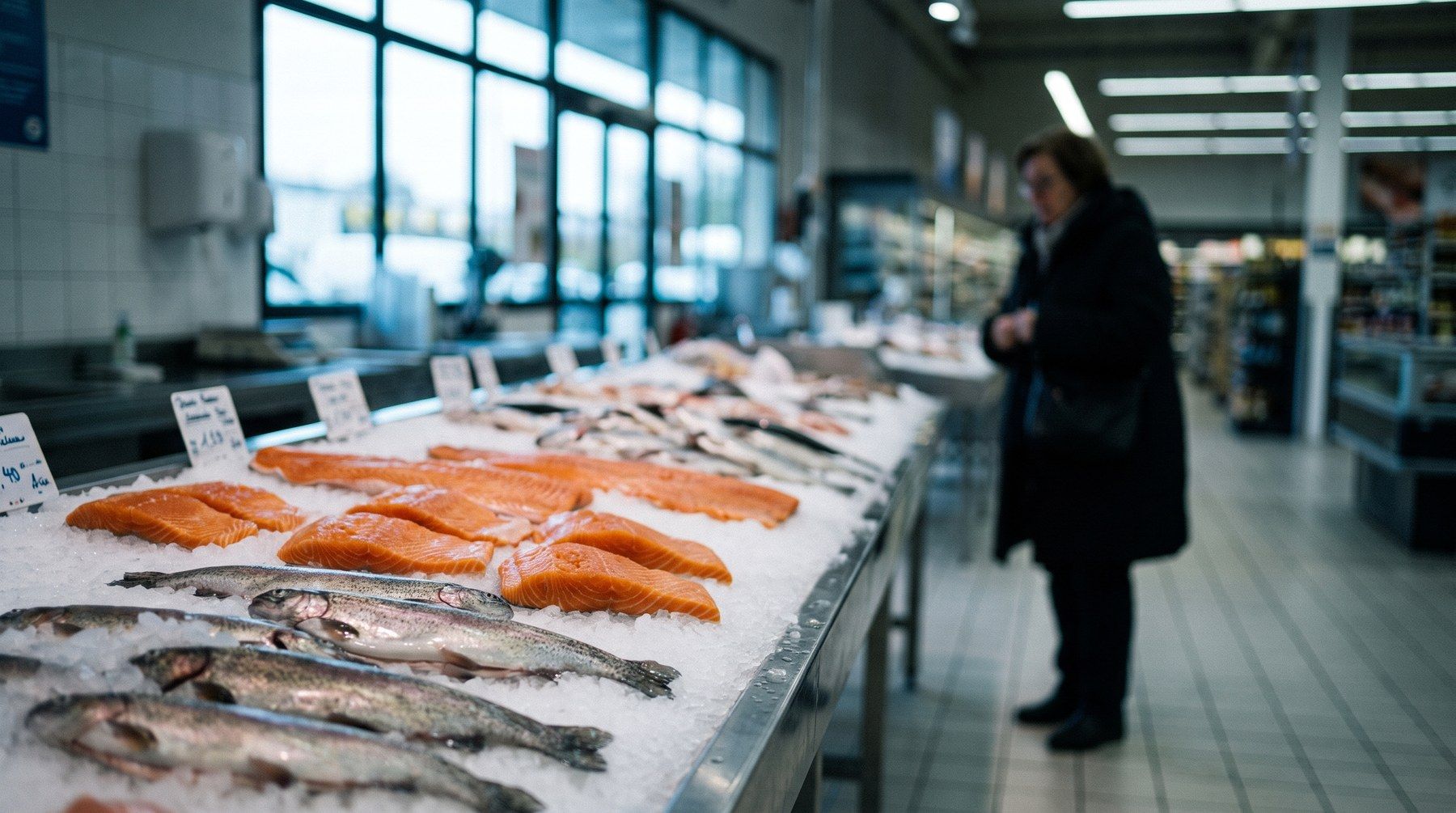
The figure to remember is this one. Nearly three quarters of the fish eaten in France comes from abroad. FranceAgriMer puts the fish self-sufficiency rate at 24% on average over the 2022-2024 period, which amounts to saying that national production covers only a quarter of it. Widened to all aquatic products, shellfish, crustaceans and cephalopods included, the ratio becomes slightly less unfavourable, with French production covering about a third of consumption.
The volumes give the measure of it. In 2023, France produced 657,000 tonnes of aquatic products, imported 1,818,000 tonnes and exported 410,000, for an apparent consumption of close to 2,065,000 tonnes in live-weight equivalent.
Consumption per head, for its part, stands at 30.8 kilograms a year and has been falling by around 1.2% a year for a decade. The dependence is not explained by a growing appetite, then, but by production that no longer keeps up.
This situation is not specific to France. More than 80% of the seafood eaten in the European Union is imported, according to a study commissioned in 2026 by the European Parliament's fisheries committee. Worldwide, aquaculture overtook capture fishing for the first time in 2022, with 94.4 million tonnes of farmed aquatic animals, but ten countries alone supply close to 90% of that. Most consumer nations therefore depend on a handful of distant producers, which makes food self-sufficiency a shared question well beyond our own borders.
Salmon, a case study in dependence
One species sums up the imbalance on its own. Salmon is the aquatic product France imports most, with close to 201,000 tonnes in 2024, or 20% of the volume and 29% of the value of our seafood purchases. Norway supplies around 88,000 tonnes of it, and the United Kingdom 65,000.
French salmonid production, for its part, is almost entirely trout. Farmed salmon produced in France is counted in hundreds of tonnes, which amounts to saying that almost all the salmon eaten in France arrives from abroad.
One point deserves to be made, because it is frequently stated the wrong way round. By value, France's leading supplier of aquatic products in 2024 was not Norway but the United Kingdom, with €1.25 billion against €909 million. Norway does keep first place on salmon alone.
This dependence carries a cost that swings sharply. The average export price of Norwegian salmon rose from around 59 kroner per kilogram in 2021 to 95 in 2023, before easing back towards 82 in 2025. Every tremor in that market reaches French shelves, with no national lever available to cushion it.
A national aquaculture output in decline
The obvious answer would be to produce more at home. The figures show the movement going the other way.
French aquaculture produced 185,372 tonnes in 2023, of which 146,384 tonnes were shellfish. Fish farming proper accounts for 38,535 tonnes, down 5.9% year on year. Salmonids for consumption represent 29,313 tonnes, down 9.3%, for a value of €151 million and an average price of €5.16 per kilogram.
The production base consists of 330 freshwater fish farms and 38 marine sites. Many of these operations are old and work under heavy constraints, whether water regulations or the availability of the resource itself. New sites remain rare, not for want of know-how, but because of a long permitting process and a capital requirement that deters projects.
In other words, the sector that could close a three-quarters dependence gap loses volume every year instead of gaining it.
Fruit and vegetables, twenty years of erosion
The picture is barely more favourable on the plant side. The self-sufficiency rate for fresh fruit and vegetables stood at 50.8% when the sovereignty plan was launched, against 64.6% in 2000, which means that one fruit or vegetable in two eaten in France is imported. A more recent estimate from the sector's trade association puts it at around 55% in 2024. Excluding citrus and exotic fruit, which the French climate cannot support, the rate rises to about 65%, which shows that the headline average somewhat overstates the real dependence.
The product-by-product detail says more than the average. According to a study carried out by FranceAgriMer with the CTIFL, France's technical centre for fruit and vegetables, the country covers 85% of its apple consumption and 81% of its onion consumption, but only 58% for tomatoes, 39% for aubergines, 30% for table grapes, 19% for peppers and 15% for raspberries.
The volume balance settles the order of magnitude. In 2024, France imported 885,000 tonnes of fresh vegetables and 2.6 million tonnes of fresh fruit more than it exported.
We are not eating more fruit and vegetables than twenty years ago. We are simply producing far less of them.
Why production is falling
Three causes combine, and none of them is corrected by a simple price adjustment.
The first is demographic. The 2020 agricultural census counts 43% of farm managers aged 55 and over, against 36% ten years earlier, and 58% past the age of fifty. Over the same period the country lost close to 100,000 farms, falling from 490,000 to 389,000 in mainland France. Every departure left unreplaced means production capacity lost, or absorbed by larger and more specialised operations.
The second is climatic. Summer droughts, water-use restriction orders and erratic yields are weakening open-field production. The summer of 2026 placed 72 départements on crisis alert for water resources, against 46 the year before, and those restrictions hit market gardening first, a sector that needs a great deal of irrigation at precisely the season when the resource runs short.
The third is economic. On products where international competition is settled on labour and energy costs, part of French production stops being competitive and disappears. Peppers and raspberries, whose self-sufficiency rates are among the lowest, are precisely the labour-intensive crops. The know-how is not in question. The economics are.
This is exactly where aquaponics offers an unusual answer. By backing market gardening with a markedly more profitable fish farming operation, it funds, on the same infrastructure, crops that on their own would not hold up against international competitors with better cost positions. National vegetable production then stops depending on its own profitability alone, and is carried by an activity that makes it viable.
What the state has committed, and what it can deliver
Public authorities have taken the measure of the subject. The sovereignty plan for the fruit and vegetable sector, presented on 1st March 2023, sets a course towards five additional points of self-sufficiency by 2030, then ten points by 2035, with €200 million mobilised in the first year and a budget of up to €400 million over two years for greenhouse modernisation, orchard replanting and equipment.
The France 2030 plan, France's national investment programme, also devotes €2 billion to agriculture and food, split between innovation, sector structuring and the setting up of new farmers, to which close to €878 million is added under the acceleration strategies.
These policies have one merit, that of existing, and one limit, that of time. An orchard, an aquaculture site or a greenhouse cannot be decreed into existence, they are built over several years. It should also be noted that aquaculture has no ring-fenced budget within France 2030, its framework falling instead under the Aquacultures d'avenir plan, France's aquaculture roadmap, and under European funds.
The levers that can actually be used
Regaining sovereignty means producing more on national territory, with fewer resources, and close to where the food is eaten. Three routes emerge from the findings above.
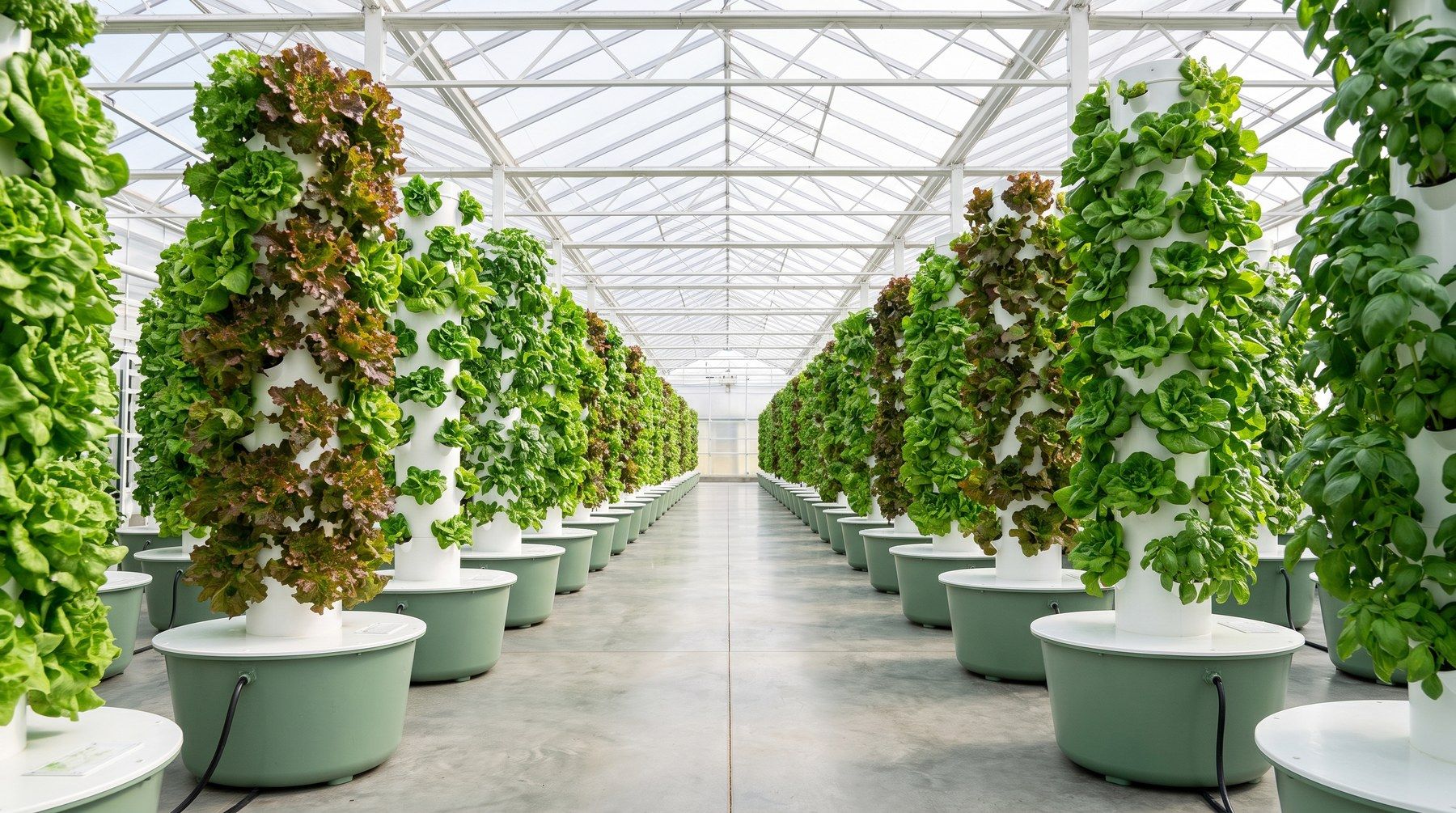
Protected cropping comes first, because it secures yields and lengthens seasons in the face of a climate that has become erratic. That is why the sovereignty plan earmarked part of its funding for greenhouse modernisation.
Frugal water use comes next, not out of virtue but out of necessity, since access to irrigation water is now restricted several weeks a year across much of the country.
Geographical proximity closes the list. It cuts out intermediaries, improves freshness and restores a direct link between producer and consumer, something retail buyers have been actively looking for over the past few years.
These three requirements point to the same conclusion. The model able to meet them will be neither traditional open-field farming nor the industrial mega-farm far from the cities, but an intermediate scale, technical, sited close to population centres.
Where aquaponics fits into this equation
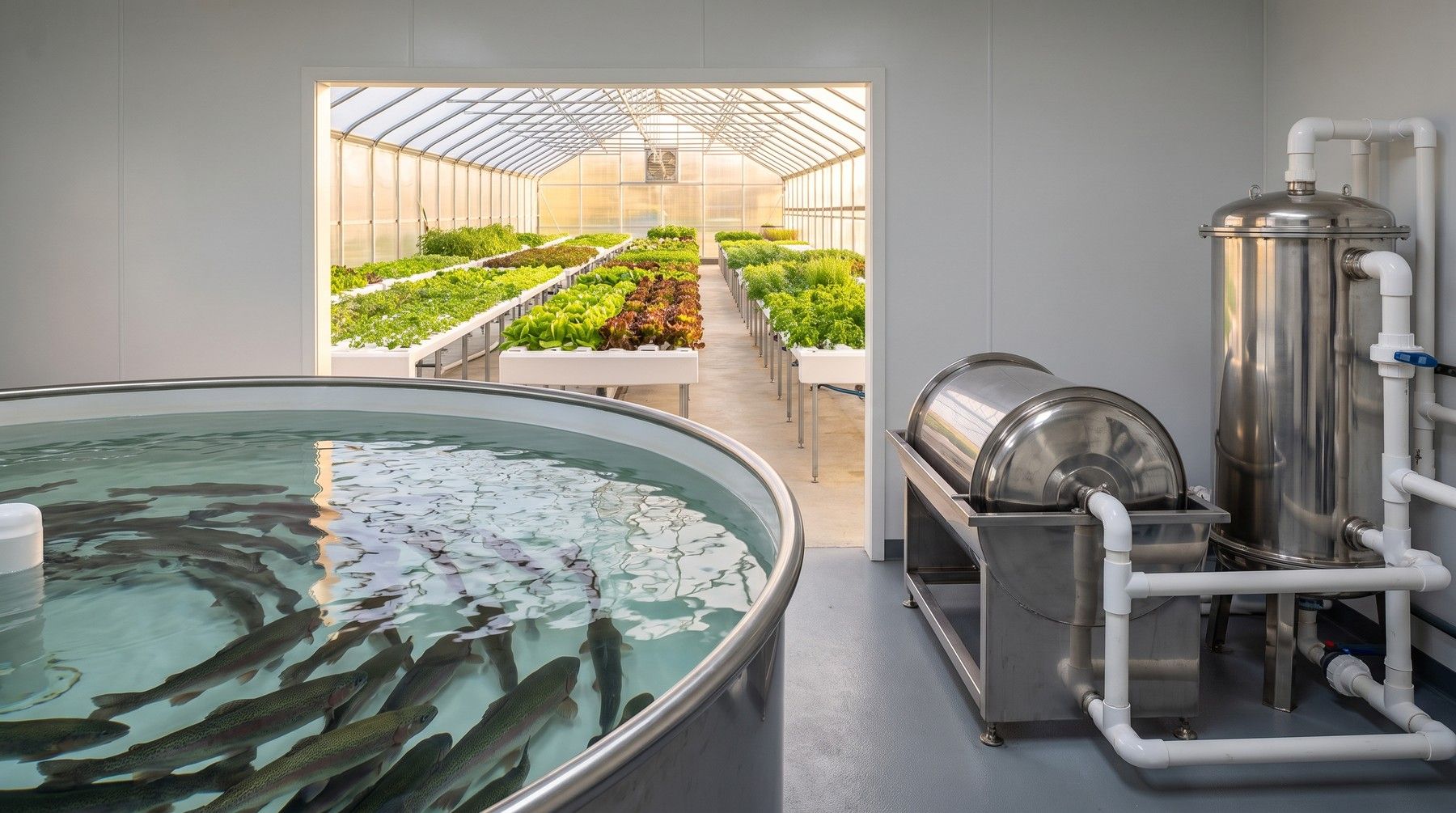
Aquaponics meets all three requirements at once. An aquaponic farm produces in a greenhouse, in a closed loop where only losses to evaporation and transpiration are made up, which closes the circuit into a genuine virtuous circle and represents, according to the FAO, about a tenth of the water the same crop requires when grown in soil. That water saving comes with production free of pesticides and antibiotics, on small areas compatible with sites at the gates of towns and cities, and therefore with short supply chains. We set out how it works in our article How does aquaponics work?.
It also has one feature that sets it apart from every other soilless growing technique, which we compare in Aquaponics, hydroponics, aeroponics: what are the differences?. It supplies both fish and plants, precisely the two categories where French dependence is sharpest. A hydroponic greenhouse handles only the second.
The sector nonetheless remains embryonic in France. The most recent tally available, carried out by ITAVI, the French technical institute for poultry and fish farming, in 2021, recorded eighteen commercial aquaponic farms in operation and as many projects, mostly micro-farms of 1,000 to 2,000 square metres selling within a radius of some twenty kilometres. Genuinely large-scale sites are still rare in France and can be counted on the fingers of one hand.
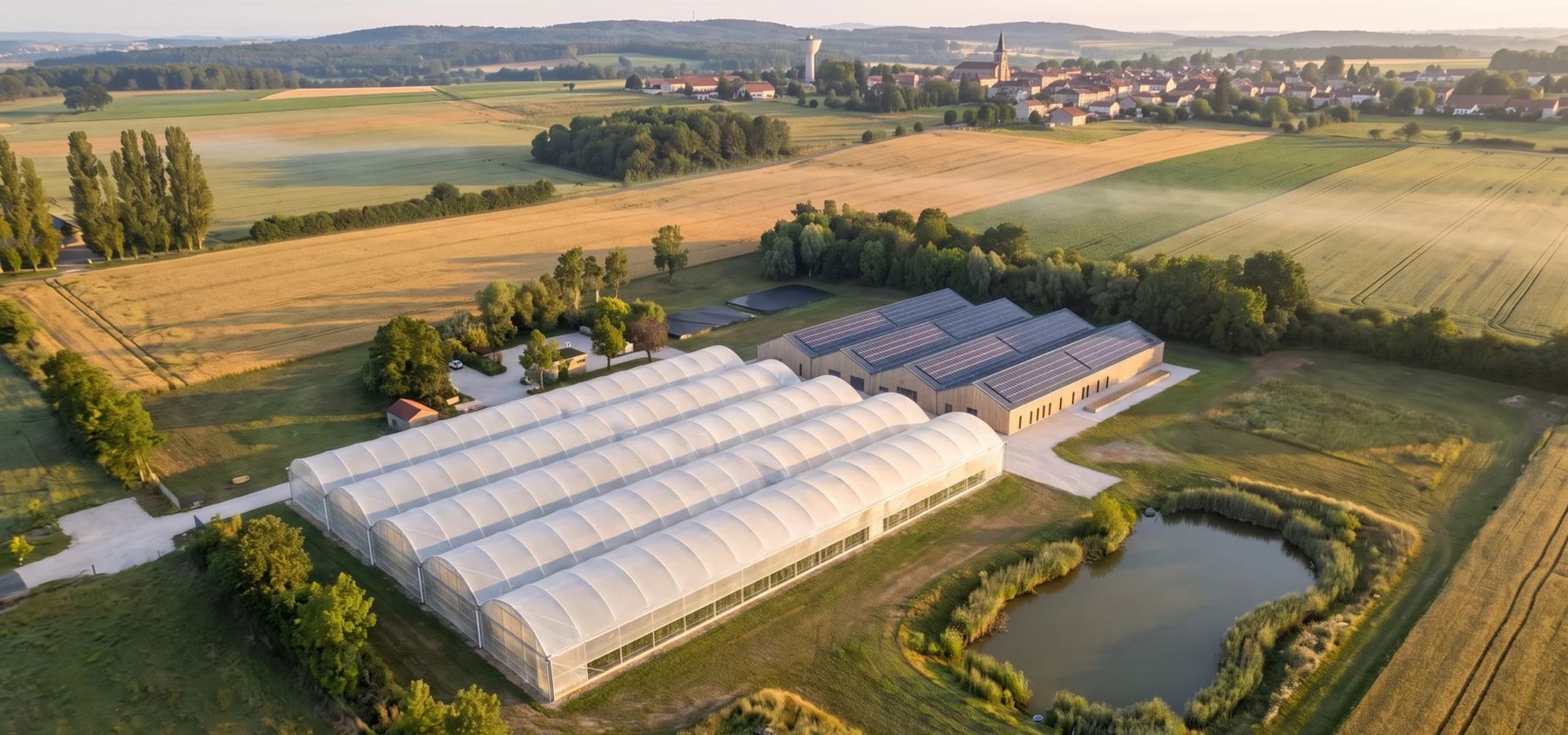
That is precisely why we are developing Aquaponeasy, a first one-hectare farm at Vic-sur-Seille, in Lorraine, north-eastern France, designed to produce locally what the area imports today.
Our contribution
This large-scale aquaponic farm, sited in the Moselle, in the Grand Est region, will target around 60 tonnes of fish and 35 tonnes of fruit and vegetables a year, close to seventy-five tonnes of net food produced on one hectare and sold within a 100 km radius. Three fish rearing halls, four production greenhouses, a research greenhouse and a processing workshop will be organised around a single water circuit. Construction starts in 2027.
These products will also be distinctive in taste and food safety, because synthetic inputs are simply impossible to use in aquaponics. A pesticide applied to the crops would run back down into the tanks, and an antibiotic given to the fish would destroy the biofilter. Here the technical constraint becomes a guarantee for the consumer, and makes this model a concrete example of sustainable agriculture serving the agricultural transition.
More than forty professional customers in the area, supermarkets, restaurants and central catering kitchens, have already signed a letter of intent covering this future production, which confirms that the demand is real and that the market is waiting for local supply. The rainbow trout and brook trout we will rear target the segment where substitution for imports is the most immediate, with local production sold through short supply chains. The farm is currently the subject of a fundraising round open to private investors and will be the first unit in a network we intend to roll out across other population centres.
So where does France really stand?
The answer comes down to three findings. Nearly three quarters of the fish and one fruit or vegetable in two eaten in France are imported. That position has deteriorated steadily over twenty years, not through excess consumption but through falling production. The causes of that decline, generational renewal, climate pressure and the competitiveness gap, do not correct themselves.
Complete self-sufficiency is neither realistic nor desirable for products the French climate does not allow the country to grow. Regaining self-sufficiency points on fish and on seasonal vegetables is, on the other hand, an achievable goal, provided the country invests in production methods that use little water, are grown under cover and are sited close to cities.
That is the bet we have made in Lorraine, in an area whose fresh fish consumption today depends almost entirely on outside supply.
Explore the investment opportunity→
Frequently asked questions
What is food sovereignty?
It is a country's ability to set its own agricultural policy and to feed its population from its own production. It is measured by the self-sufficiency rate, the ratio between national production and domestic consumption.
How much of the fish eaten in France is imported?
Nearly three quarters. FranceAgriMer, the French agricultural and seafood products agency, puts the fish self-sufficiency rate at 24% on average over 2022-2024. The 93% figure sometimes quoted is a different indicator, the import dependency rate, which does not subtract what France re-exports after processing.
How much of its fruit and vegetables does France produce?
About half, with a self-sufficiency rate of between 51% and 55% depending on the method used, against almost 65% in 2000. Excluding citrus and exotic fruit, which the French climate cannot support, the rate rises to around 65%.
Why is French production falling?
Three factors combine. Generational renewal, since 43% of farm managers were over 55 in 2020 and those leaving are not being replaced. Climate pressure on open-field yields, made worse by irrigation restrictions. And a competitiveness gap against imports on the most labour-intensive crops.
Can France become self-sufficient again?
Full self-sufficiency is neither realistic nor desirable for products the climate does not allow the country to grow. Regaining self-sufficiency points on fish and on vegetables, on the other hand, is achievable, provided the country invests in production methods that use little water and sit close to where the food is eaten.
How does aquaponics contribute to food sovereignty?
It produces under cover, in a closed loop that uses around ten times less water than open-field growing, on small areas close to cities. Above all it supplies both fish and plants, the two categories where French dependence is greatest, and it backs market gardening with a more profitable fish farming operation that makes it viable.
How many aquaponic farms are there in France?
There is no official count, as aquaponics appears neither in the aquaculture survey run by Agreste, the French agriculture ministry's statistics service, nor in the agricultural census. The only tally available, published in 2021 by ITAVI, the French technical institute for poultry and fish farming, recorded eighteen commercial farms in operation and as many projects, mostly sites of 1,000 to 2,000 square metres. Genuinely large-scale units can be counted on the fingers of one hand.